
We count visits to see which pages are helpful – nothing is sold on. Privacy policy

NLL Guides · GUIDE

How much paint do exterior walls need? Calculate the quantity

Dorde Lalic, founder and owner of NLL MåleriDorde Lalic founder and ownerNLL Måleri · · 8 min readLinkedIn
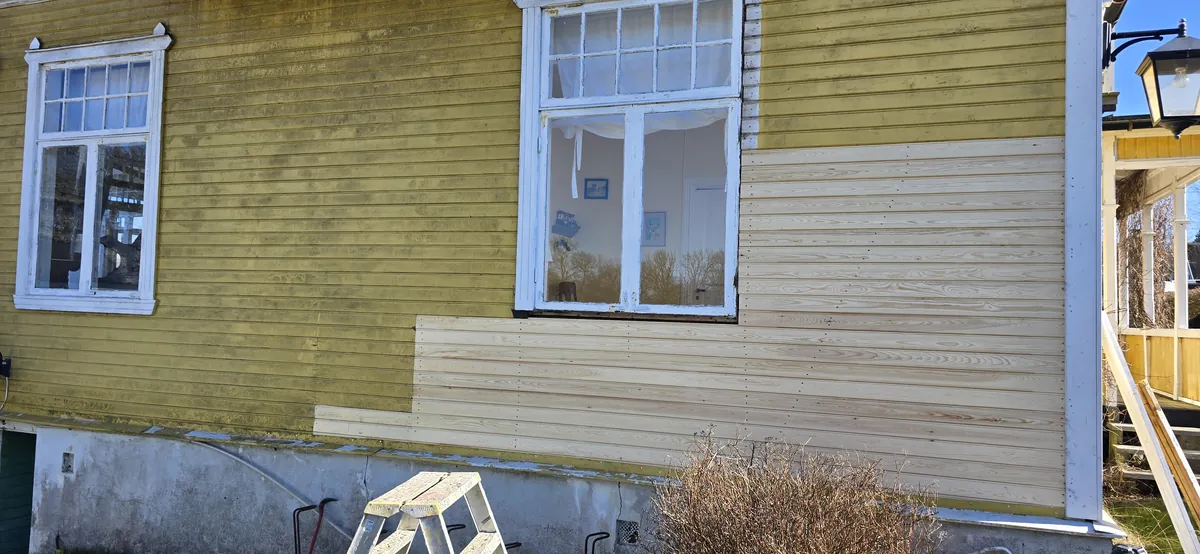
Yellow timber cladding and white windows with covered surfaces during exterior work in Arild.

Project photo from Arild. Timber cladding, windows and junctions are included in the surface assessment.

Paint in litres = painted façade area × number of coats ÷ paint coverage in m²/l. For a 120 m² façade, two coats and coverage of 8 m²/l, this gives 30 litres of topcoat. Primer and wastage are additional in this worked example.

Quick answer
  • Measure the façade to be painted; the house's floor area is a different measurement.
  • Calculate each paint product separately using its own coverage and number of coats.
  • At 6–8 m²/l, 10 litres cover 30–40 m² in two coats, before wastage.
  • Add primer, details and a reserve where the work requires them.
  • The litre calculation gives material requirements. NLL's price calculator gives an initial cost estimate with labour and materials shown separately.

How do you calculate paint quantities for a façade?

Measure the area receiving the same paint, subtract unpainted openings and use the product's coverage. Window trim, corner boards and other details need a separate calculation if painted with another product.

Measure a rectangular wall as width × height. Measure a triangular gable as width × height ÷ 2. Add the parts and subtract windows and doors that will not receive façade paint. A home with 120 m² of floor area does not automatically have 120 m² of façade.

Nordsjö's calculation instructions use the same principle: painted area, number of coats and the product's m²/l figure. Do not make a general exception for small windows; calculate the areas you actually intend to paint.

Worked example: 120 m² façade with two coats

Assume 140 m² of walls and gables, including 20 m² of openings that will not be painted. That leaves 120 m². With two coats and 8 m²/l, the calculation is (140 − 20) × 2 ÷ 8 = 30 litres of topcoat. The example excludes primer and wastage allowance and is not a measurement of your house.
Calculate the paint quantityWorked example: (140−20) m² × 2 ÷ 8 m²/l = 30 l of topcoat, excluding primer and wastage.Calculate the paint quantityPainted areaNumber of coatsProduct coverage in m²/lLitres
Worked example: (140−20) m² × 2 ÷ 8 m²/l = 30 l of topcoat, excluding primer and wastage.
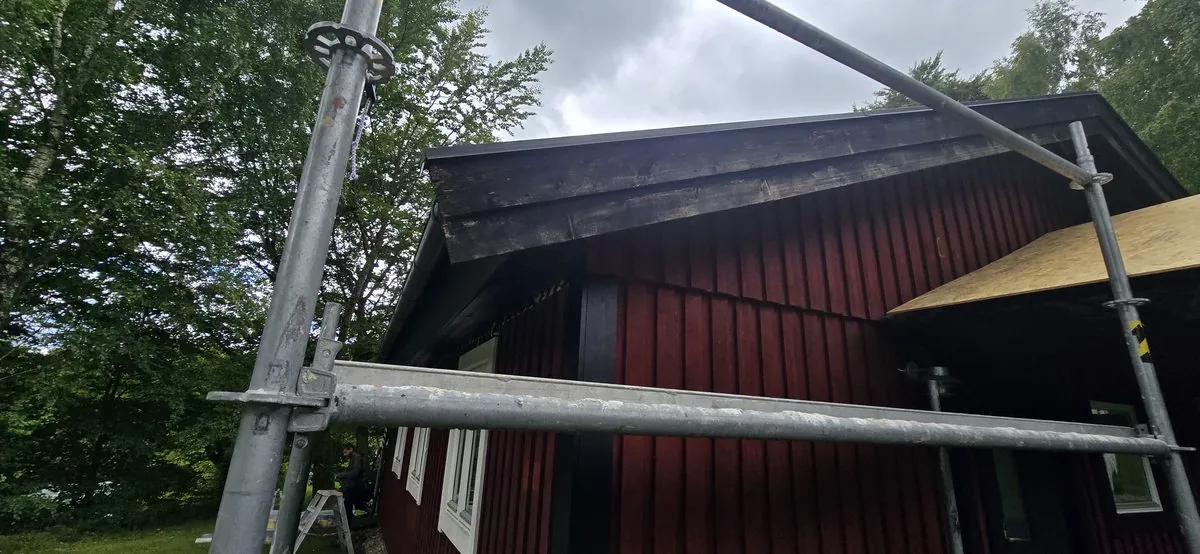
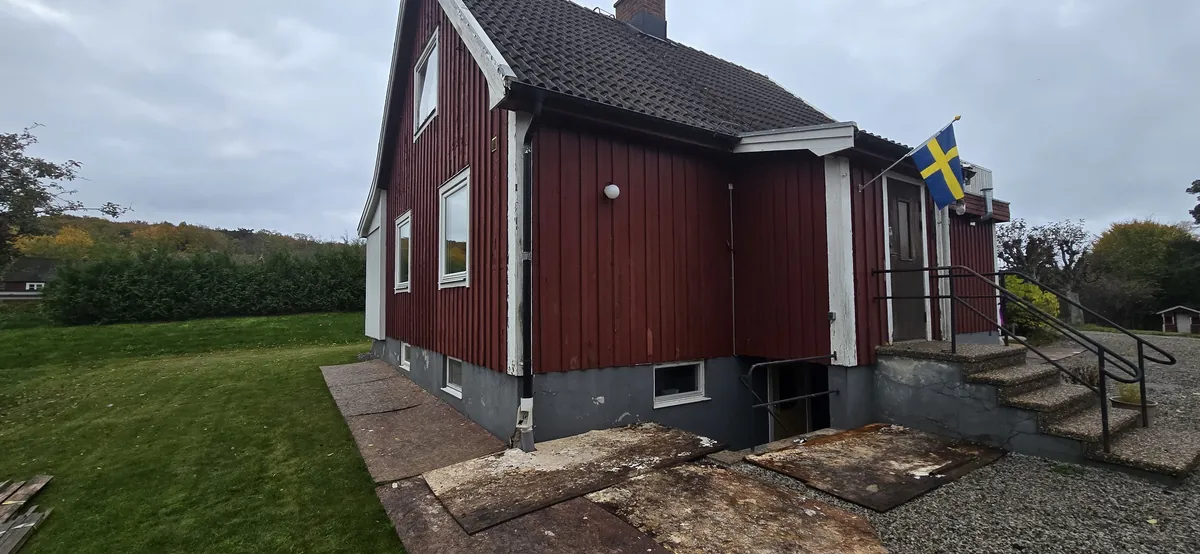
Red vertical timber cladding, white windows and a grey plinth on a house in Båstad.
Project photo from Båstad. The cladding's condition and junctions determine the preparation required.

How much paint is needed per square metre?

At coverage of 6–8 m²/l, approximately 0.13–0.17 litres per m² are needed for one coat, or 0.25–0.33 litres for two. This is a calculated range for that coverage, not a universal consumption rate for all exterior paints.

As a product example, Beckers Perfekt Fasad specifies 6–8 m²/l and two finishing coats. Follow the instructions for the product and surface used on your project; the example does not mean NLL has selected that product for your house.

Calculated topcoat quantity at 6–8 m²/l, two coats, excluding wastage and primer:

Calculated topcoat quantity at 6–8 m²/l, two coats, excluding wastage and primer
Painted façade areaAt 8 m²/lAt 6 m²/l
30 m²7.5 l10 l
100 m²25 l33.3 l
120 m²30 l40 l
200 m²50 l66.7 l

Figures are rounded only in the table. Choose container sizes from the full calculation and the reserve you need.

How far does 10 litres of exterior paint go?

10 litres cover 60–80 m² in one coat or 30–40 m² in two coats if the product's coverage is 6–8 m²/l. The same wall area is painted twice. If your paint has different coverage, calculate 10 × m²/l ÷ number of coats.

How far 10 litres goCalculated at 6–8 m²/l. The same area is painted twice; wastage and primer are excluded.How far 10 litres goOne coat60–80 m²Two coats30–40 m²Coverage used in the calculation6–8 m²/l
Calculated at 6–8 m²/l. The same area is painted twice; wastage and primer are excluded.

How much extra paint do absorbent and untreated surfaces need?

There is no universal percentage allowance for every absorbent façade. Use the product instructions for the actual surface and check consumption on a representative section before ordering the full quantity.

Rough cladding, porous render and previously treated timber have different properties. Coverage for timber paint should not be used to order render paint. Note both the material and existing treatment when calculating.

If priming is needed, calculate it separately using the primer's coverage. Primer is not automatically used in greater quantities than topcoat; treated area, product and number of coats determine consumption. The guide to priming a façade explains when this stage is needed.

Check the surface before buyingNo universal percentage for all absorbent surfaces. Use the correct product's instructions.Check the surface before buyingMaterialsExisting treatmentTest on a representative area
No universal percentage for all absorbent surfaces. Use the correct product's instructions.
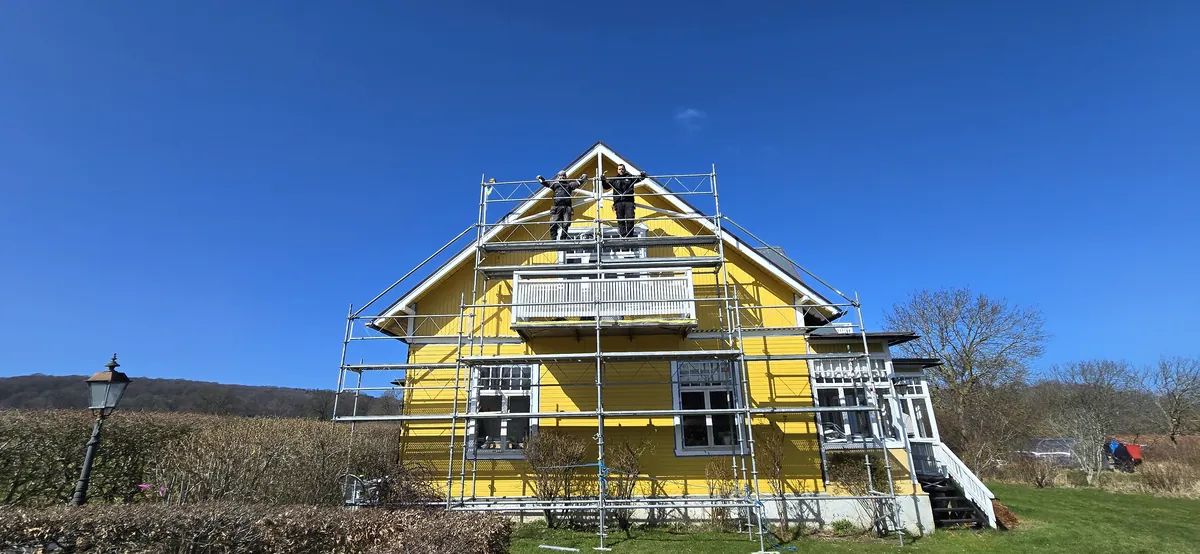
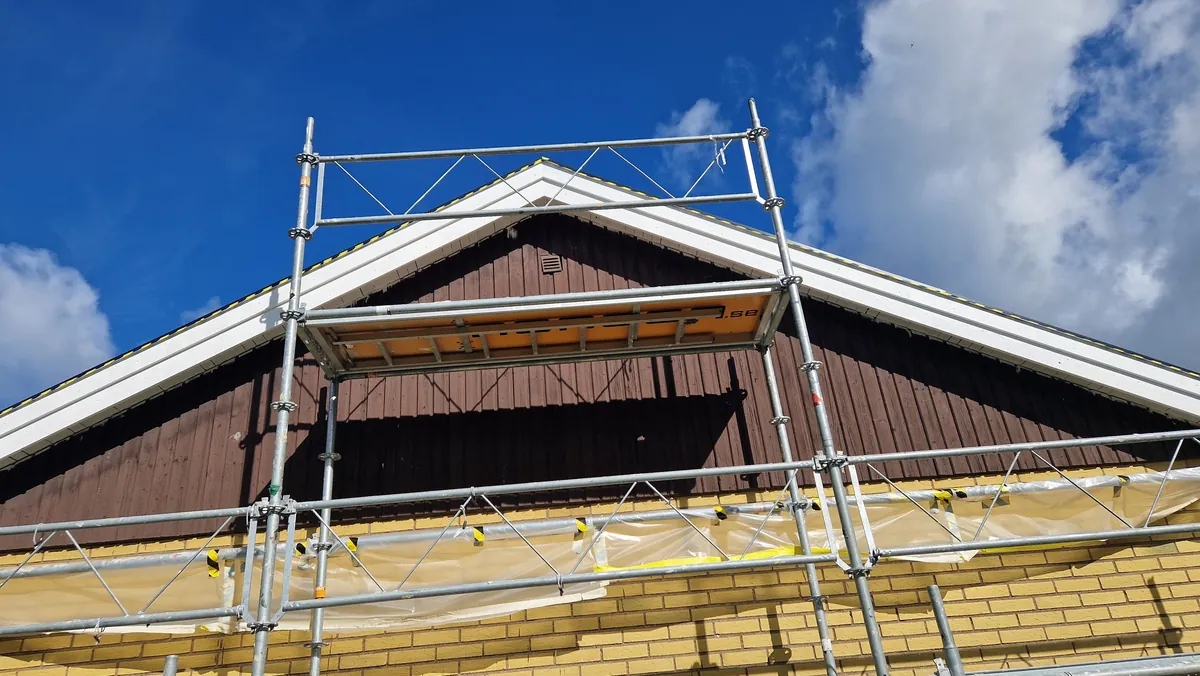
Exposed gable and scaffolding during timber cladding replacement in Billinge.
Project photo from Billinge during cladding replacement on the gable.

How many coats are needed and how does this affect the quantity?

Take the number of coats from the paint system's application instructions. Two coats with the same calculated consumption need twice as much topcoat as one; calculate primer separately.

How many coats are needed and how does this affect the quantity?
Part of the paint systemHow to calculate
Priming bare timber areasArea to prime × number of primer coats ÷ primer coverage
Topcoating the whole façadeEntire painted area × number of topcoats ÷ topcoat coverage
Trim and corner boards in another paintDetail area × number of coats ÷ that product's coverage

A colour that appears opaque after the first coat does not itself mean the specified treatment is complete. Follow the stated quantities and drying times too. Plan the wait between stages with the guide to how long house painting takes.

Calculate each product separatelyCalculate primer, topcoat and paint for details separately using each area, coverage and number of coats.Calculate each product separatelyPrimed areasTopcoated façadeTrim and corner boards
Calculate primer, topcoat and paint for details separately using each area, coverage and number of coats.

What does paint cost compared with labour when painting a façade?

Paint cost is calculated from the products and quantities you buy. A price per m² for painting labour is a different calculation and should not be read as the cost of paint tins.

NLL Måleri's indicative price for labour on timber façades is 625–875 SEK/m² including VAT before any applicable ROT tax deduction. For labour on rendered and brick façades, the indicative price is 500–750 SEK/m² including VAT before any applicable ROT tax deduction. Materials and other costs are assessed separately; these labour prices are not a total price for a finished façade.

Use the cost calculator for your project for an initial cost estimate. Read about exterior wall painting by NLL when you want help with the work, or compare the cost items in our guide to painting the outside of your house.

Labour and materials are different costsNLL's indicative prices cover labour including VAT before any applicable ROT tax deduction. Materials and other costs are charged separately.Labour and materials are different costsTimber façade625–875 SEK/m²Render and brick500–750 SEK/m²Labour including VATbefore any applicable ROTMaterials and other costsseparately
NLL's indicative prices cover labour including VAT before any applicable ROT tax deduction. Materials and other costs are charged separately.

Frequently asked questions

How much paint is needed for 100 m² of façade?

At 6–8 m²/l and two coats, approximately 25–33.3 litres of topcoat, before wastage and any primer. The 100 m² must be the area actually painted, not the house's floor area.

Should I buy as much primer as topcoat?

Calculate the products separately. If only some bare timber areas need priming, the primed area is smaller than the topcoat area. Use each product's coverage and number of coats.

How much extra paint is needed for wastage?

Choose a reserve based on application method, details, surface and product instructions. A fixed allowance for every house can lead to buying the wrong amount. Keep the reserve visible in the calculation rather than changing the measured façade area.

Can the calculator provide a binding quote?

The price calculator provides an estimate. A price for specific work requires an assessment of scope and surface. Send the area, photos and requested work through NLL's quote request.

Updated

Updated

Request a fixed price

Estimate your project cost

Estimate your project cost

Select the service, scope and customer type. The calculator loads here.

Request a quote